GUID vs UUID: What They Are and How to Generate Them
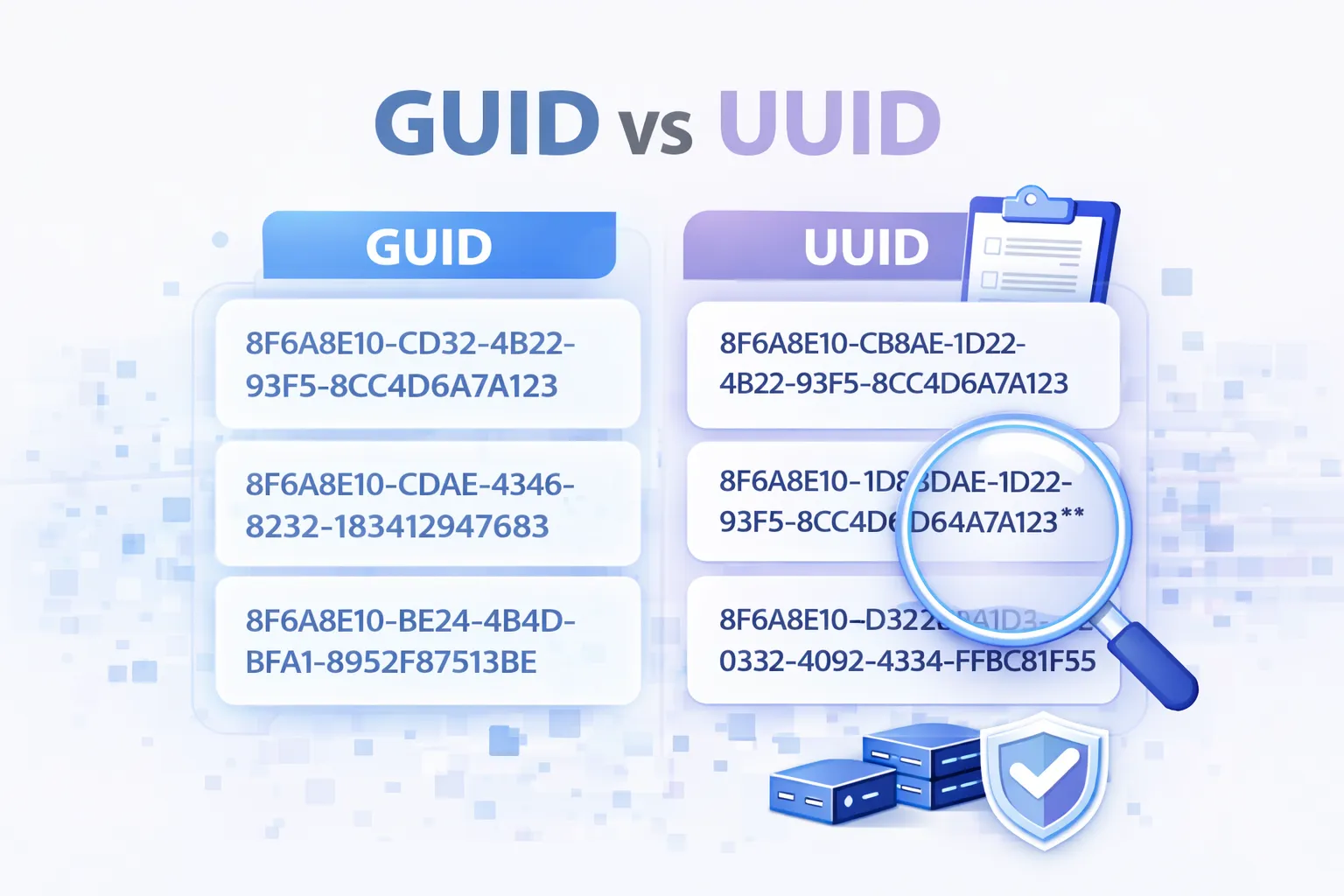
If you have ever seen an identifier like f47ac10b-58cc-4372-a567-0e02b2c3d479, you have already used a GUID or UUID.
They are both 128-bit identifiers designed to be globally unique, even across different machines and moments in time. You will see them in databases, APIs, event streams, logs and distributed systems.
In practice, the name difference causes more confusion than the actual format, so let us clear that up quickly.
What is a GUID or UUID?
A UUID (Universally Unique Identifier) is the standards-based name defined in RFCs. A GUID (Globally Unique Identifier) is the Microsoft/.NET naming convention for the same kind of value.
They are represented as 36-character strings (including hyphens), with 32 hexadecimal characters and 4 separators.
Example: 550e8400-e29b-41d4-a716-446655440000
Are GUID and UUID the same?
Functionally: yes.
Most teams use the terms interchangeably. The differences are usually ecosystem and wording, not behavior:
- UUID is the standards term used broadly across languages and platforms.
- GUID is the term commonly used in Windows and .NET documentation and APIs.
If your system says GUID and another says UUID, they are almost always compatible as long as both use the same version and canonical format.
How to generate them
The most common versions in modern systems are v4 and v7.
Version 4 (random)
UUID v4 is mostly random.
- Easy and widely supported
- Great default for distributed systems
- Collision risk is negligible at real-world scale
Use v4 when sort order does not matter and you want simple, robust uniqueness.
Version 7 (time-ordered)
UUID v7 combines a timestamp with randomness.
- Preserves uniqueness
- Sorts naturally by creation time
- Better for append-heavy tables, event logs and write patterns where index locality matters
Use v7 when chronological ordering is useful or when you want more storage/index friendliness than fully random IDs.
Quick generation examples
.NET (GUID)
var id = Guid.NewGuid();
Console.WriteLine(id);
JavaScript (UUID v4)
const id = crypto.randomUUID();
console.log(id);
Python (UUID v4)
import uuid

id = uuid.uuid4()
print(id)
Practical guidance
- Choose one naming convention per codebase and document it.
- Prefer v4 when you just need uniqueness.
- Prefer v7 when ordered identifiers improve query patterns.
- Store identifiers in a consistent format across services.
- Avoid exposing internal sequencing assumptions in public APIs.
Final thoughts
GUID and UUID are two labels for the same concept: globally unique 128-bit identifiers.
The important decision is usually not the name, but the version you generate and how consistently you use it throughout your architecture.
If you are starting fresh, v4 is still a great default. If ordering and index behavior matter, v7 is often the better fit.
If you want the easiest, fastest and rfc-compliant browser-based guid generator to quickly create and inspect unique identifiers, visit GUIDsGenerator.com.
Further reading
For a deeper breakdown of GUID vs UUID formats, see the GUID vs UUID wiki on GUIDsGenerator.com.
Thank you for reading.
-Bruno